-1.png?width=292&height=64&name=LeaderStat%20Logo%20(4)-1.png)
-2.png?width=1100&name=Blog%20Banners%20(9)-2.png)
Introduction
Agency reduction has become a top priority across post-acute care. Rising costs, inconsistent staffing, and increased pressure on internal teams have pushed many organizations to look for alternatives.
But while the goal is clear, the path to achieving it often is not.
Many providers attempt to reduce agency usage by tightening budgets or limiting hours. The data shows that approach alone rarely delivers lasting results.
Organizations that successfully reduce agency reliance take a different path. They focus on transforming their workforce strategy.
The Reality: Why Agency Reduction Efforts Stall
Across post-acute care, common patterns emerge when agency reduction efforts fall short:
- Hiring processes vary by location
- Recruiting is reactive rather than proactive
- Leadership lacks visibility into workforce trends
- Open roles remain unfilled, increasing reliance on agency
Without addressing these underlying challenges, agency becomes a fallback rather than a choice.
The result is a cycle many organizations know well:
Reduce agency → experience staffing gaps → return to agency.
What the Data Shows
When organizations implement a centralized workforce strategy, the results look very different.
In one recent post-acute partnership, a multi-community provider achieved: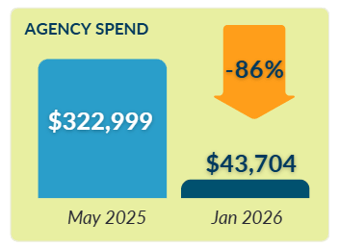
- Significant reduction in agency spend
- Improved candidate flow across locations
- Faster time-to-fill for critical roles
- Greater consistency in hiring practices
More importantly, these improvements were sustained over time, not just short-term gains.
The difference was not simply adding more recruiters or filling more roles. It was creating a system that supported consistent hiring outcomes.
The Shift: From Staffing to Systems
The most successful organizations shift their mindset from:
-1.png?width=832&height=61&name=%E2%80%9CHow%20do%20we%20fill%20open%20roles%E2%80%9D%20to%20%E2%80%9CHow%20do%20we%20build%20a%20workforce%20system%20that%20prevents%20gaps%E2%80%9D%20(1)-1.png)
This includes:
- Centralized recruiting processes across communities
- Standardized screening and hiring workflows
- Better data visibility and reporting
- Alignment between operations, HR, and leadership
With the right structure in place, organizations move from reacting to staffing challenges to preventing them.
Where Workforce Strategy & Recruitment Process Support Fits In
A thoughtful workforce strategy, paired with retention consulting and strong recruitment process support, helps organizations move from reactive staffing to a more sustainable model.
By strengthening internal systems and aligning hiring practices across communities, organizations gain:
- Centralized visibility into workforce needs
- Scalable recruiting support aligned to demand
- Data-driven insights to improve hiring decisions
- Consistent, standardized hiring processes
This approach goes beyond filling open roles. It focuses on building the infrastructure needed to support long-term stability, improve retention, and reduce reliance on agency staffing.
Rather than functioning as an external vendor, this model integrates with your team to enhance internal capabilities and create a more consistent, effective workforce strategy.
Beyond Cost Savings
While cost reduction is often the initial goal, the impact goes further:
- Improved staff retention
- Stronger leadership stability
- Better patient and resident outcomes
- Reduced operational disruption
Agency reduction is not just a financial win. It is a foundation for long-term organizational stability.
Conclusion
The data is clear: agency reduction is not achieved through limits or short-term fixes.
It requires system-level change.
Organizations that invest in workforce strategy, align leadership, and implement centralized hiring models are the ones seeing measurable, lasting results.
Because in post-acute care, stability is not accidental.
It is built.
Is your organization ready for a new staffing strategy? Connect with our team!


LeaderStat specializes in direct care staff, interim leadership, executive recruitment, travel nursing and consulting for healthcare organizations nationwide.
-1.png?width=258&name=LeaderStat%20Logo%20(4)-1.png)